This store requires javascript to be enabled for some features to work correctly.

Tel: 0121 773 4222 | Email: info@karatgoldsmiths.co.uk
  • Diamond Rings
    • Our Range
      • Engagement Rings
      • Eternity & Wedding Bands
      • Bespoke Diamond Rings & Jewellery
    • Guidance
      • Why Choose Lab Grown Diamonds
      • ENGAGEMENT RINGS
        ENGAGEMENT RINGS
      • Eternity & Wedding Bands
        Eternity & Wedding Bands
  • Jewellery
    • Fine Jewellery
      • Rings
      • Earrings
      • Nose Rings
      • Bangles
      • Necklaces
    • Guidance
      • About Our Precious Metals
      • Ring Stacking Guide
      • Beauty of Asian Jewellery
      • Stacking Rings
        Stacking Rings
  • About
  • Services
  • Contact
Karat Goldsmiths
  • 0
  • Diamond Rings
    • Our Range

      • Engagement Rings
      • Eternity & Wedding Bands
      • Bespoke Diamond Rings & Jewellery
    • Guidance

      • Why Choose Lab Grown Diamonds
    • ENGAGEMENT RINGS
      ENGAGEMENT RINGS
    • Eternity & Wedding Bands
      Eternity & Wedding Bands
  • Jewellery
    • Fine Jewellery

      • Rings
      • Earrings
      • Nose Rings
      • Bangles
      • Necklaces
    • Guidance

      • About Our Precious Metals
      • Ring Stacking Guide
      • Beauty of Asian Jewellery
    • Stacking Rings
      Stacking Rings
  • About
  • Services
  • Contact
Karat Goldsmiths
Search 0 Cart

Lab-grown diamonds · Gold settings · Bespoke designs

Diamond Engagement Rings

Choose a diamond engagement ring that suits your partner, your budget and the way they wear jewellery. At Karat Goldsmiths, we offer lab-grown diamond rings online and at our Birmingham boutique, alongside a bespoke service for clients who want a custom design.

Compare diamond shapes, settings and gold colours, then speak with our team about sizing, certificates and wedding-band pairing. Visit us at 581 Stratford Road, Birmingham B11 4LS, or call +44 121 773 4222 to arrange a consultation.

Arrange a Birmingham consultation Browse our gold and diamond jewellery
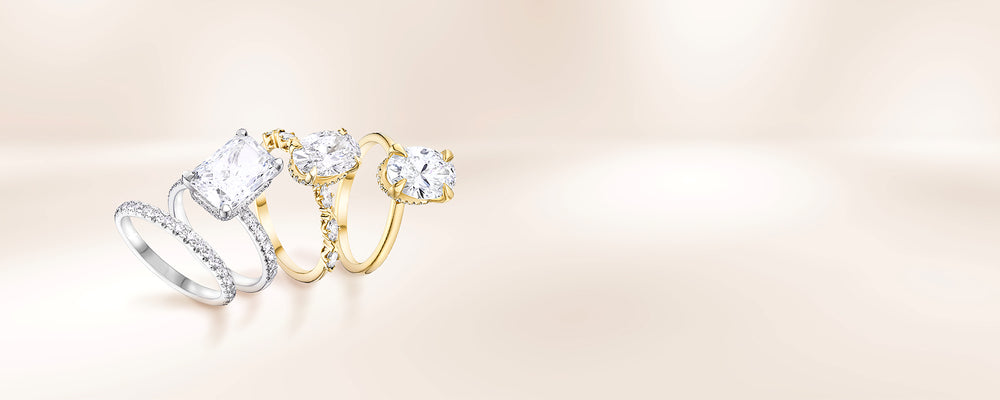
Three diamond engagement rings in white and gold on a soft beige background
Shop diamond engagement rings Call our Birmingham boutique Discuss a bespoke ring

Settings and profiles

Find Your Diamond Engagement Ring Style

Start with the overall shape of the ring. The setting controls how much diamond you see, how high the centre stone sits and how the ring pairs with a wedding band.

Solitaire engagement rings

A solitaire places one diamond at the centre of the design. The open setting gives the stone space and suits round, oval, pear, emerald and princess cuts.

A raised solitaire can sit beside a straight wedding band. A low setting may leave a gap, so compare both rings from the side before choosing.

Choose a solitaire if you want

  • A clear focus on one diamond
  • A design that suits many diamond shapes
  • Access around the stone for cleaning
  • Scope to change the band width or gold colour

Halo engagement rings

A halo surrounds the centre diamond with smaller stones. It creates a broad field of sparkle and can accentuate the outline of an oval, cushion, pear or round diamond.

Check the side profile if you plan to wear a straight wedding ring. Some halos sit close to the finger and suit a shaped or contoured band.

Pavé and diamond-set bands

A pavé band adds small diamonds along the shoulders of the ring. The centre diamond remains the focus while the band catches light across the finger.

Fine settings need care. Avoid gripping hard tools or lifting heavy weights while wearing a pavé ring, and ask us to check the stones if the ring receives a knock.

Three-stone engagement rings

Three-stone designs place a centre diamond between two side stones. You can match all three shapes or use tapered, pear or marquise-cut shoulder stones to frame the centre.

The extra stones add width, so compare the full proportions against the wearer’s finger rather than assessing the centre diamond alone.

Cluster engagement rings

A cluster brings several diamonds together in one setting. Jewellers can arrange the stones into a floral, geometric or asymmetric shape.

Clusters suit clients who favour texture and detail. The spaces between the diamonds need more attention during cleaning than a plain solitaire.

Toi et moi and bypass rings

A toi et moi ring places two stones beside each other. A bypass band curves around the stones and creates an open, asymmetric profile.

This style offers scope for mixed diamond shapes, such as pear and oval. It can also suit a proposal ring with personal symbolism.

View the pear-cut lab-grown diamond bypass ring

Outline and brilliance

Choose a Diamond Shape

Diamond shape affects the outline, brilliance and apparent size of your ring. Compare shapes on the hand, since photographs cannot show every proportion.

Karat Goldsmiths diamond engagement ring

Round

Round brilliant diamonds produce a balanced pattern of light and suit solitaire, halo and three-stone settings. Their symmetry makes them easy to pair with many wedding-band styles.

Oval

An oval diamond offers the sparkle associated with a brilliant cut in an elongated outline. Its length can give a larger face-up appearance than some diamonds of the same carat weight.

Oval diamonds vary in length-to-width ratio and bow-tie effect. Compare individual stones before making your choice.

Emerald

An emerald-cut diamond uses long step facets and a broad table. The cut draws attention to clarity, colour and facet alignment.

Choose an emerald cut after viewing the stone rather than relying on the grading report alone. The large, open facets can make inclusions easier to see.

Cushion

A cushion-cut diamond combines a square or rectangular outline with rounded corners. Facet patterns vary, so two cushion diamonds with matching grades can show different patterns of brilliance.

Pear

A pear diamond combines a rounded end with a tapered point. The shape suits solitaire, halo and two-stone designs.

The setting should protect the pointed tip with a suitable prong or bezel. You can wear the point towards or away from the hand according to preference.

Princess

A princess-cut diamond has a square outline and sharp corners. It offers a geometric look with brilliant-style faceting.

A protective setting helps shield the corners during everyday wear.

Radiant

A radiant-cut diamond combines a rectangular or square outline with cropped corners and a brilliant facet pattern. It suits clients who like the outline of an emerald cut with a livelier pattern of reflected light.

Available online

Featured Lab-Grown Diamond Rings

Two gold rings with diamonds on white satin fabric

Pear-Cut Lab-Grown Diamond Bypass Ring in Solid Gold

A curved bypass design with a pear-cut lab-grown diamond. View the product page for the current price, metal details, diamond specifications and availability.

Shop the pear-cut lab-grown diamond bypass ring
Karat Goldsmiths lab-grown diamond ring

Oval Lab-Grown Diamond Ring with Marquise Shoulders and Hidden Halo

An oval centre diamond framed by marquise-cut shoulders, with a hidden halo beneath the main setting. View the current product details before ordering or contact us to discuss size and availability.

View the oval lab-grown diamond ring

Understand your options

Natural or Lab-Grown Diamond?

A natural diamond develops in the earth over a vast period. A laboratory creates a lab-grown diamond under controlled conditions that reproduce the heat and pressure involved in diamond growth.

Both types have a carbon crystal structure and display the optical properties associated with diamond. Their origin, price and supply history differ.

Our jewellery range includes lab-grown diamond pieces. If you want to compare a lab-grown stone with a natural diamond, call us before your visit to confirm our current sourcing and viewing options.

Compare them by your priorities

Budget and size

Lab-grown diamonds often allow you to consider a larger stone or higher specifications within a set budget. Prices vary according to cut, colour, clarity, carat weight and the individual ring design.

Natural diamonds follow a different supply and pricing structure. Decide how much of your budget you want to place into the centre stone, setting and gold.

Appearance

The origin does not give you a reliable visual test. Compare each diamond through its proportions, facet pattern and grading details.

A well-chosen smaller diamond can show more life than a larger diamond with a weak cut. View the stone in different light where possible.

Certification

Ask for the grading report that accompanies the diamond. Check that the report number and stone details correspond with the ring or loose stone under consideration.

Grading laboratories use their own report formats. We will explain the documentation supplied with the diamond you choose. Contact us if you require a report from a named laboratory, since availability depends on the individual stone.

Provenance and ethics

Ask direct questions about origin, manufacturer, supplier standards and available records. Lab-grown production still uses energy and resources, so broad environmental claims require evidence from the producer.

Natural diamond sourcing raises a different set of questions about mining and chain of custody. We can discuss the information available for a specific stone before you commit.

Long-term priorities

Choose according to the proposal, the person wearing the ring and your financial limits. Sentimental value comes from the relationship and the meaning you attach to the ring. Future resale prices can change, so avoid treating either diamond type as a guaranteed investment.

Compare stones with confidence

The Four Cs Without the Jargon

Diamond graders assess cut, colour, clarity and carat. The grades help you compare stones, but your eyes should make the final choice.

Karat Goldsmiths diamond rings

Cut

Cut describes the proportions, symmetry and polish that control how a faceted diamond handles light. Shape describes the outline, such as round, oval or pear.

Place cut quality near the top of your priorities. A diamond with strong light performance can look lively across a room, while extra carat weight cannot correct weak proportions.

Fancy shapes need individual assessment. Oval, pear and marquise diamonds can show dark bow-tie areas. Emerald cuts depend on balanced step facets and clean reflections.

Colour

Colour grades measure the presence of body colour in a diamond. Stones near the colourless end of the scale can carry a higher price.

The setting affects perception. Yellow or rose gold can complement a diamond with a warmer tone. White gold creates more contrast, so compare the loose stone beside your chosen metal.

Clarity

Clarity grades describe internal features called inclusions and surface features called blemishes. Position, size and visibility all affect the grade.

Many clients choose an eye-clean diamond, where normal viewing does not reveal distracting inclusions. This can release more of the budget for cut, size or the ring setting. Ask to inspect inclusions near the centre or close to vulnerable corners.

Carat

Carat measures diamond weight rather than visible width. Two diamonds with the same carat weight can face up at different sizes because their proportions and shapes differ.

Check the millimetre measurements on the grading report. A balanced spread, good cut and suitable setting can matter more than reaching a target carat number.

Allocating a fixed budget

Use this order as a starting point

  1. Set the total amount you can spend without relying on salary rules.
  2. Reserve part of the budget for the setting and gold.
  3. Prioritise cut and a pleasing face-up appearance.
  4. Choose a colour that works with your preferred metal.
  5. Select eye-clean clarity rather than paying for features you cannot see.
  6. Compare carat weight with millimetre dimensions.

Our team can adjust this order around a preferred shape or design. An emerald cut may need more clarity consideration, while a yellow-gold setting may give you more freedom on colour.

Colour, purity and construction

Choosing Gold for an Engagement Ring

Gold colour changes the character of a diamond ring. Gold purity affects strength, colour and the way a goldsmith constructs the setting.

Karat Goldsmiths gold diamond rings

18k gold

18k gold contains 75% pure gold. Other metals in the alloy add strength and create yellow, white or rose tones. UK hallmarks use the fineness mark 750 for 18k gold.

18k gold suits many engagement-ring settings because it balances a high gold content with the strength required for daily wear. The exact alloy affects colour, hardness and care needs.

24k gold

24k gold contains close to pure gold and carries a rich yellow colour. UK hallmarks may use the fineness mark 999.

Pure gold has more softness than 18k alloys. Fine prongs and exposed stone settings need enough strength to hold a diamond through years of wear, so 24k gold may not suit each component or design.

Our work with 18k and 24k gold combinations gives you scope to use colour and purity with care. We assess the setting, band thickness and wearer’s routine before confirming a mixed-gold design.

Yellow gold

Yellow gold brings warmth to a diamond ring and suits classic or ornate designs. It can also complement diamonds with a warmer colour grade.

White gold

White gold creates a bright setting that blends with the colour of a diamond. Many white-gold rings use a rhodium finish, which may need renewal as wear exposes the underlying alloy.

Rose gold

Rose gold takes its pink tone from the alloy mix. It pairs well with warm skin tones and suits vintage-inspired, halo and mixed-metal designs.

Mixed-gold rings

A bespoke ring can combine gold colours or purities in separate sections. You might choose a rich yellow band with a white setting around the diamond, helping the setting blend with the stone.

The design needs to account for differences between alloys. We will assess the joins, setting structure and future maintenance before starting the piece.

UK hallmarking

UK law sets hallmarking requirements according to metal type and item weight. An authorised assay office tests qualifying gold jewellery and applies marks that identify metal fineness and other required details.

Ask us to show you the hallmark and explain each mark when you collect or view your ring.

For more detail on gold, platinum and other jewellery metals, read our guide to precious metals.

Made around your preferences

Our Bespoke Engagement Ring Process

A bespoke engagement ring gives you control over the diamond, metal and setting. You can bring a clear design or start with a few preferences.

1

Share your brief and budget

Tell us about the wearer’s style, everyday routine and existing jewellery. Bring reference images if you have them. We will discuss your budget without using salary formulas or pressure-led targets.

Useful details include

  • Preferred diamond shape
  • Lab-grown or natural diamond preference
  • Gold colour and purity
  • Approximate ring size
  • Proposal date
  • Wedding-band plans
2

Choose the diamond and setting

We will discuss suitable stones and setting structures according to current availability. You can compare carat weight, dimensions and grading details alongside visual appearance.

The wearer’s routine affects our setting advice. A low profile may suit active hands, while a raised setting may allow a straight wedding band to sit closer.

3

Review the design

Depending on the ring, we may use sketches, design references or computer-aided design as part of the approval process. We will confirm the design method during your consultation.

Check the ring from the top and side. Pay attention to setting height, band width and the space available for a wedding ring.

4

Confirm the quotation and schedule

We will confirm the specification, price, payment requirements and expected production schedule before manufacture. Bespoke timescales depend on design complexity, stone sourcing and workshop capacity.

Tell us about your proposal date at the first consultation. We will confirm whether the workshop can meet it before you place the order.

5

Manufacture and quality checks

Our team will make the ring to the agreed specification and inspect the setting, finish and stones. We will contact you according to the collection or delivery arrangement agreed for your order.

6

Fitting and aftercare

Try the ring on and check the fit. We can explain cleaning, storage and future inspection needs for the chosen setting.

Resizing depends on the band, stone arrangement and amount of change required. Ask us about the resizing scope before approving a full pavé, eternity-style or intricate bespoke design.

Discuss your bespoke engagement ring

Bring your preferences, budget and target date to a consultation with our Birmingham team.

Start your bespoke engagement ring enquiry

Plan a surprise with confidence

Ring Sizing and Surprise Proposals

You can buy an engagement ring without knowing the exact size, but a good estimate reduces the chance of major alterations.

Karat Goldsmiths diamond engagement ring

Estimating size in secret

Try one of these methods

  • Borrow a ring your partner wears on the correct finger and bring it to us.
  • Press the ring into a soft bar of soap to record the inner circumference.
  • Trace the inside edge on paper.
  • Ask a friend or family member who can keep the proposal private.
  • Compare the borrowed ring against a ring-size guide without guessing from finger appearance.

Finger sizes differ between hands. A ring worn on the right hand may not match the left ring finger.

If the size is wrong

Contact us before wearing the ring for an extended period. We will inspect the design and advise whether our workshop can resize it.

A plain band or solitaire often offers more scope than a ring with diamonds around the full circumference. Large size changes can affect stone alignment, setting tension and band shape.

We cannot confirm a resizing outcome until our jeweller examines the ring and knows the required size change.

Choosing a proposal size

A modest size adjustment gives a jeweller more options than a major change. If you have no reliable size information, contact us before ordering. We can discuss the setting and its alteration limits.

Keep the purchase documents and diamond report in a safe place. Bring them with you if the ring needs an assessment.

Plan the pair together

Pairing an Engagement Ring with a Wedding Band

The side profile determines whether a straight wedding ring will sit close to the engagement ring.

A raised centre setting often leaves room underneath for a straight band. Low halos, large baskets and bypass settings may need a curved or shaped wedding ring.

Consider both rings during the engagement-ring consultation if you want a close fit. We can check:

  • The space beneath the centre setting
  • Contact points between the two rings
  • Band width and height
  • Diamond coverage
  • Matching or mixed gold colours
  • Scope for a fitted bespoke wedding band

Some wearers prefer a visible gap. Others choose a shaped band that follows the engagement ring. Try both arrangements before deciding.

Karat Goldsmiths engagement ring and wedding band

Everyday protection

Engagement Ring Care

Diamonds resist scratching, but settings and gold still collect dirt and suffer wear. A hard knock can loosen a claw or damage an exposed diamond corner.

Karat Goldsmiths diamond ring on satin

Cleaning at home

Use warm water, mild washing-up liquid and a soft brush unless the product care instructions state another method. Clean beneath the diamond, where hand cream and soap collect.

Rinse the ring in a bowl rather than over an open drain. Dry it with a soft, lint-free cloth.

Avoid chlorine bleach, abrasive cleaners and rough brushes. Remove the ring before swimming, cleaning, gardening or lifting heavy objects.

Storage

Keep the ring in its own lined compartment or box. Diamonds can scratch other jewellery, while harder surfaces can mark gold.

Setting checks

Inspect the ring after a knock and contact us if the diamond moves, catches on fabric or produces a faint rattle. A jeweller should also check fine claws and diamond-set shoulders as part of ongoing care.

White-gold rings may need a fresh rhodium finish after wear. The timing depends on use, skin chemistry and the original finish.

Our Stratford Road boutique

Visit Karat Goldsmiths in Birmingham

Visit our boutique to compare ring styles, discuss lab-grown diamonds and explore bespoke gold options with our team.

Karat Goldsmiths

581 Stratford Road
Birmingham
B11 4LS
United Kingdom

Phone: +44 121 773 4222

Please call before travelling to confirm current opening hours, appointment availability and the rings available to view.

During your consultation, we can discuss

  • Your budget and preferred diamond shape
  • Lab-grown diamond options
  • Gold colour and purity
  • Ring size and proposal plans
  • Bespoke design requirements
  • Wedding-band compatibility
  • Diamond reports and product specifications

Remote clients can contact us by phone or through our website. Please ask us to confirm delivery availability, charges, payment terms, returns, warranty cover and aftercare for your chosen ring before ordering.

Arrange a Birmingham consultation

Helpful answers before you choose

Diamond Engagement Ring FAQs

Karat Goldsmiths diamond engagement ring
How much should I spend on an engagement ring?

Choose an amount that fits your finances and leaves room for the setting, sizing and any planned wedding band. Salary-based rules do not account for your commitments or priorities.

Tell us your full budget at the start. We can compare diamond sizes, grades and settings without pushing the centre stone beyond it.

Do I need to know the ring size before purchasing?

You can start your search without the exact size. An estimate helps us choose a suitable setting and assess future resizing options.

Bring a ring that your partner wears on the correct finger if possible. Contact us before ordering a complex pavé or full diamond-set band, since these designs can restrict resizing.

Are lab-grown diamonds real diamonds?

Yes. A laboratory grows them with the carbon crystal structure and optical properties associated with diamond. Their laboratory origin distinguishes them from natural diamonds and from simulants such as cubic zirconia.

Ask to see the grading details and product specification for the diamond under consideration.

Are lab-grown diamonds ethical?

Lab-grown diamonds avoid diamond mining, but ethical and environmental assessments also depend on energy sources, labour standards and the manufacturer’s records. Ask for evidence behind any sourcing or sustainability claim.

We can discuss the information available for a specific diamond rather than applying one claim to the whole category.

Do lab-grown diamonds look different from natural diamonds?

Origin alone does not give you a dependable visual distinction. Specialist equipment and grading analysis can identify growth features.

Compare cut, colour, clarity and proportions when assessing appearance.

Which diamond certificate should I choose?

Choose a report from a recognised grading laboratory and check that its number and specifications match the diamond. The report should record details such as measurements, carat weight, colour and clarity.

Laboratory availability varies between stones. Ask us which report accompanies your chosen diamond and request a named laboratory before ordering if you have a preference.

Can I customise an engagement ring?

Yes. Our bespoke jewellery service can cover diamond shape, setting style, gold colour and design details. We can also discuss 18k and 24k gold combinations where the structure suits the intended use.

Bring reference images, a budget and your target date to the first consultation.

Can you resize every engagement ring?

No jeweller can resize each design without limits. Plain bands and some solitaire rings offer more scope. Full pavé bands, tension settings and intricate patterns may restrict alteration.

We will inspect the ring and required size change before confirming whether our workshop can resize it.

Can I buy a ring for a surprise proposal?

Yes. Bring any size clues and tell us that you plan a surprise. We can discuss designs with practical resizing scope and help you consider a proposal size.

Avoid borrowing a ring from a different finger unless you account for the size difference.

Will a straight wedding ring fit beside my engagement ring?

A straight band depends on the engagement ring’s setting height and side profile. Low settings and some halos leave a gap or require a shaped band.

Discuss the wedding ring before approving a bespoke engagement-ring design if you want both rings to sit close together.

Does 24k gold suit an engagement ring?

24k gold has a rich colour and high purity, but its softness limits its use in some diamond settings. Fine claws and exposed structures often need the strength of an alloy such as 18k gold.

We can assess a mixed 18k and 24k design according to the band, setting and wearer’s routine.

What is the difference between an engagement ring and a wedding ring?

An engagement ring marks the proposal and often features a centre diamond or decorative setting. Partners exchange wedding rings during the marriage ceremony, and wedding bands tend to use a simpler profile.

Many wearers place both rings on the same finger. Check their heights, widths and contact points before choosing the pair.

How should I care for my engagement ring?

Clean it with warm water, mild washing-up liquid and a soft brush, subject to its specific care instructions. Store it away from other jewellery and remove it for swimming, cleaning or heavy work.

Contact us if a stone moves, a claw catches or the ring receives a hard knock.

Online, in our boutique or made for you

Choose Your Ring with Our Birmingham Team

Karat Goldsmiths diamond engagement ring

Browse our diamond engagement rings online, visit our Stratford Road boutique or speak with us about a bespoke design. We will help you compare diamond shapes, lab-grown options, gold combinations and settings within your budget.

Visit: 581 Stratford Road, Birmingham B11 4LS Call: +44 121 773 4222

Arrange a Birmingham consultation Start your bespoke engagement ring enquiry

Shop diamond engagement rings

SHOP
  • Earrings
  • Bangles
  • Stacking Rings
  • Necklaces
  • Diamond Rings
COMPANY
  • About
  • Services
  • Bespoke Jewellery Design
  • Privacy Policy
  • Shipping & Returns
  • Terms of Service
Contact us

581 Stratford Road

Birmingham

B11 4LS

Tel: 0121 773 4222

Email: info@karatgoldsmiths.com

  • © 2026, Karat Goldsmiths
  • Website by Lionsorbet
    American Express Apple Pay Diners Club Discover Google Pay Klarna Maestro Mastercard Shop Pay Union Pay Visa
  • © 2026, Karat Goldsmiths
  • Powered by Shopify

Subscribe to get 10% off your first order

Sign up for promotions, discounts and updates.

This site is protected by hCaptcha and the hCaptcha Privacy Policy and Terms of Service apply.